


The rules of travel distribution are changing faster than ever. Artificial intelligence is no longer a buzzword but a market reality: AI-native travel. Inspiration, planning, booking and service are being redesigned. AI agents now guide travelers throughout the process and can complete bookings autonomously.
This dynamic was more visible than anywhere else at one of the leading global hotspots for digital travel innovation: The Phocuswright Conference 2025 in San Diego. No other topic dominated the stage like AI. Hardly a single session without it.
At a Glance
The travel industry is experiencing its biggest transformation since online bookings emerged. AI is becoming the new front door to travel: more travelers are using it for planning and soon for booking. Classic search is losing relevance. Discovery is shifting into conversational flows with AI agents. Market leaders such as Expedia and Booking.com already offer agent-powered one-stop bookings, and Google Gemini has just joined the movement.
The future of travel is AI-native: personalized, automated and seamlessly convenient. Those who move now will help shape the transformation. Those who wait risk falling behind.
Four Key Insights from Phocuswright Conference 2025
Since the 1990s, Phocuswright has been the epicenter of debates around online distribution, later digital marketing and the influence of Google and other gatekeepers. Rarely has it been so singularly focused as this year. AI was everywhere. Time to summarize what matters.
1. AI is truly everywhere
Not just at the conference. AI usage for travel planning in the United States has surged to 39 percent (Phocuswright Research). And more importantly: the measurable trend continues upward. These users also tend to have higher travel budgets and a stronger willingness to explore.
2. AI is replacing Search
According to researchers Mitra Sorrells and Pete Comeau, the rapid rise of AI platforms comes at the expense of traditional web search. Review sites such as Tripadvisor and social discovery remain stable, but companies like Google are losing first access to high-value travelers.
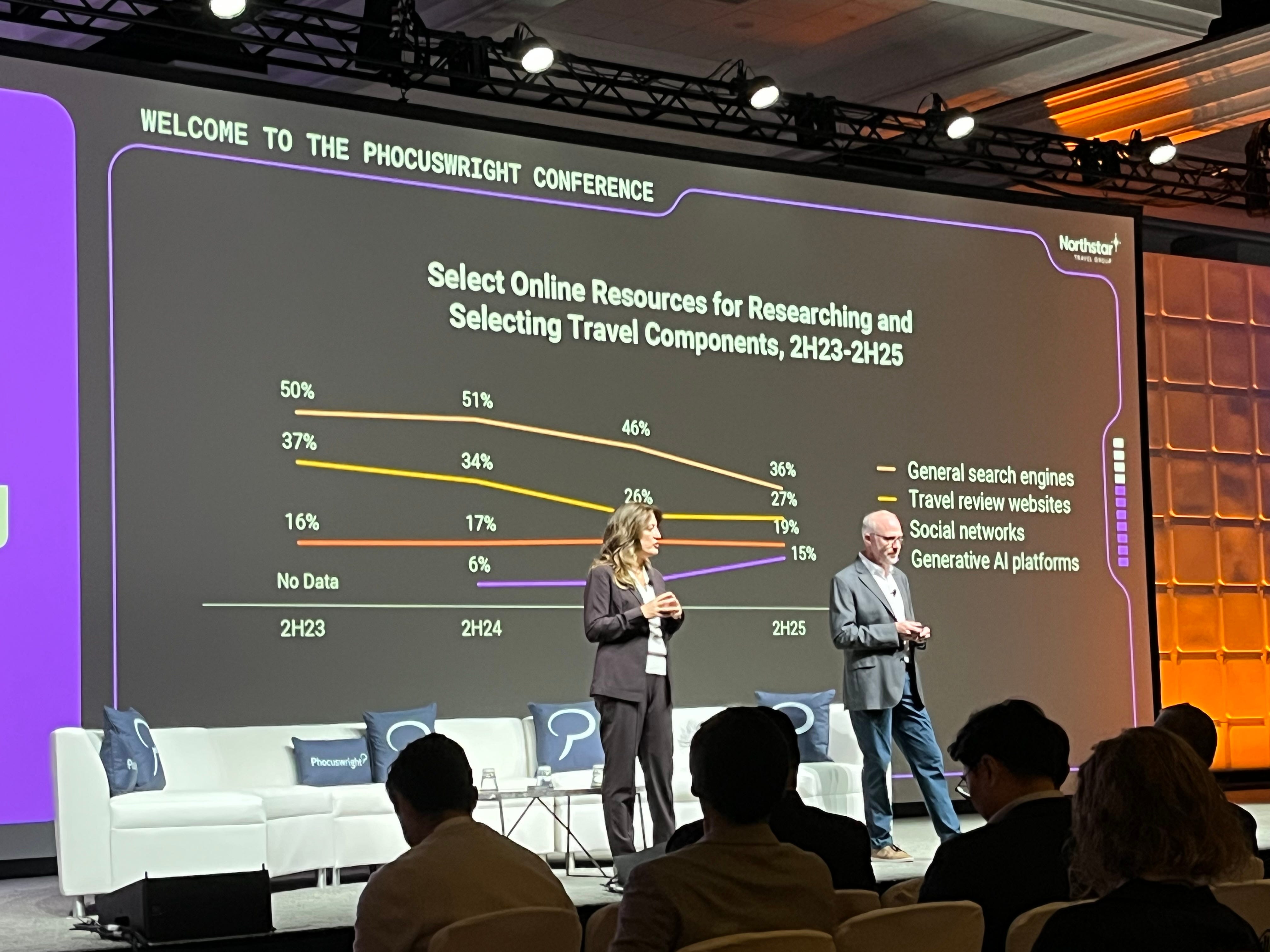
Phocuswright’s Mitra Sorrells and Pete Comeau deliver facts and figures. AI-Use is rising, Internet-Search is going down. Th chart highlights this shift clearly (better visible in this LinkedIn Pulse):
2. AI alone is not enough
Google’s Product Manager James Bryers emphasized that true value emerges only when AI connects to everything that matters in travel: rich and structured content, reliable availability data, accurate pricing and real commerce execution.
Here is a clip from the session:
This is also the foundation of Google’s new Agentic Booking Model, presented one day before the conference. It mirrors the concept behind OpenAI’s Agentic Commerce approach. One-stop shopping including payment, initially limited to a few partners (Expedia, Booking.com, selected hotel groups). It is not yet available in Europe.
4. AI does not wait
Expedia, Booking and several U.S. hotel groups are among the launch partners able to execute agentic bookings via high-performance MCP server infrastructure. More will follow.
America first — out of respect for the EU, not for Trump
MCP servers and intelligent automation are advancing rapidly, but most solutions become available in Europe with noticeable delay. This is not due to political preference, but rooted in respect (and sometimes fear) of strict European regulation. Data protection rules, the Digital Markets Act and the upcoming AI Act are only partially compatible with rapid experimentation. The United States is currently setting the pace — Europe must translate its strengths in trust and compliance into competitive speed.
Travel.Commerce., will help lead the conversation and be host of some great events on the eTravelStage in Hall 6.1 at ITB Berlin.
• 4 March – AI Track o
• 5 March – Travel Tech Track
This can become another beginning of a new era. It’s just getting started. Game on.